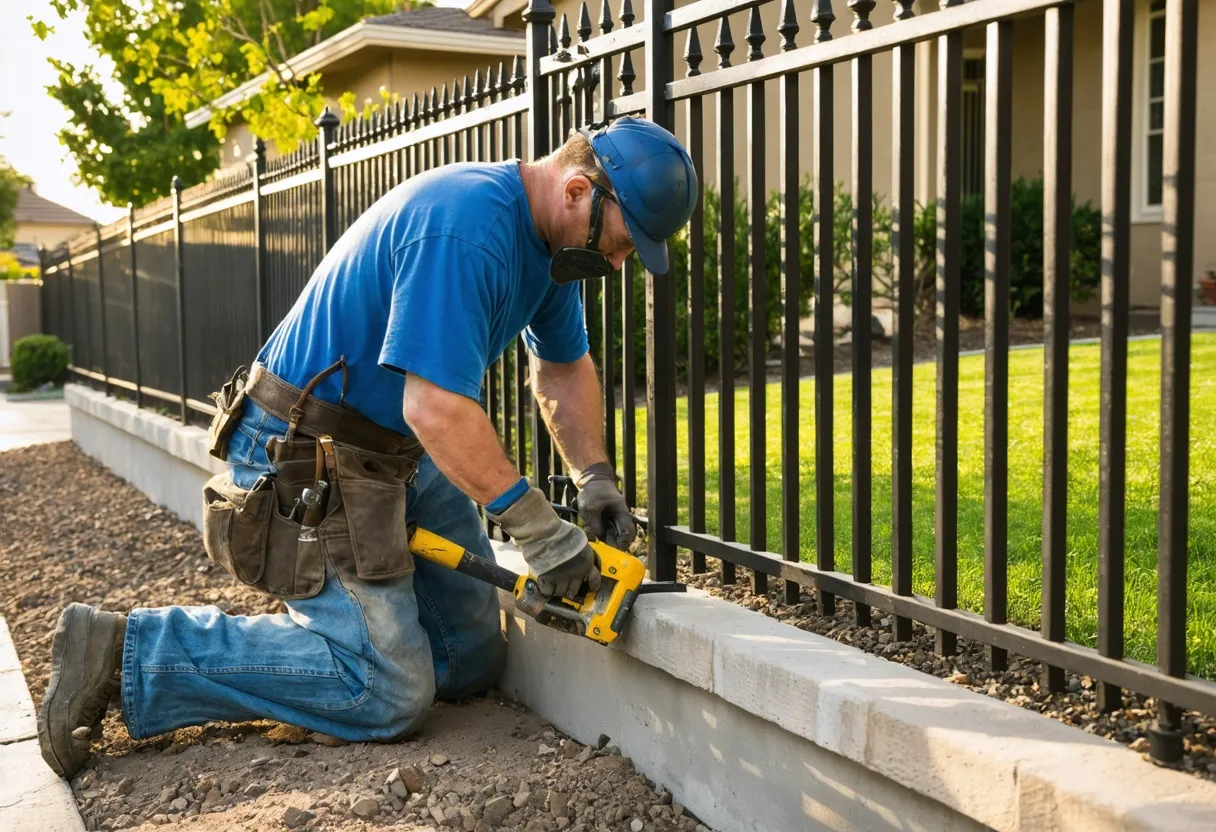
Search "wrought iron fence Chandler" and you'll find the same two blank spots on almost every page you click: nobody gives you real numbers to plan around, and nobody mentions that Chandler's pool-barrier code will already decide half your design before you've picked a picket style. If your backyard has a pool — and across this city, a lot of backyards do — that code isn't a footnote. It sets your fence height, your picket spacing, and how your gate latches, and it requires a permit before anyone breaks ground.
This page fills both gaps directly. You'll get a clear breakdown of what drives the cost of an ornamental iron fence or gate in Chandler, AZ, and a plain-English walkthrough of the pool-barrier requirement so you're designing to code from the first conversation instead of discovering a problem at inspection. No sales pitch required to get either.
What "Wrought Iron" Actually Means When You Get a Quote
Almost nothing installed as residential fencing today is true hand-forged wrought iron — blacksmith-forged iron fencing is largely a craft of the past. What you're buying when you request an iron fence installation in Chandler, AZ is ornamental iron fencing: steel pickets and rails, welded into panels at a fabrication shop, then powder-coated for corrosion resistance. The term "wrought iron" survives because it describes a look — vertical pickets, clean sightlines, optional decorative finials and scrollwork — rather than the literal metal-working process. That distinction matters for your quote, because what you're actually paying for is picket gauge, spacing, finial detail, and finish quality, not a material that no longer exists in most residential supply chains.
Picket spacing is where this stops being cosmetic. On a standard front-yard or side-yard panel, spacing is largely a style choice. On a fence or wrought iron gate enclosing a pool in Chandler, spacing is dictated by code — the gaps have to be tight enough that a young child can't squeeze between pickets or use the horizontal rails as a ladder to climb over. That single requirement changes the fabrication spec, the amount of steel in each panel, and where the gate latch has to sit. We cover the full code detail in the next sections, but it's worth knowing up front: a quote that doesn't distinguish between decorative spacing and pool-barrier spacing is a quote that hasn't actually been designed for your property yet.
Why the material holds up here specifically
Chandler's climate is hard on fencing that depends on organic material or plastic composites. Intense direct sun year-round and the strong gusts that come through during summer monsoon season will dry and crack wood, and can warp or discolor vinyl over time. Powder-coated steel doesn't rot, doesn't splinter, and doesn't soften in heat — and posts set properly in concrete footings hold their line under wind load far better than a lightweight panel system. That durability-to-maintenance ratio is the core reason ornamental iron has become a default choice for pool perimeters and street-facing fences across the city, not just an aesthetic preference.
What an Ornamental Iron Fence Actually Gets You in a Chandler Yard
What Actually Moves the Price on a Wrought Iron Quote
Iron fencing has a wider price range than almost any other material we install, because so many independent variables stack on top of each other. We won't put a number on this page that isn't tied to your specific property — anyone who quotes a flat per-foot price sight unseen is guessing — but here's exactly what an itemized estimate for a wrought iron fence or gate in Chandler accounts for:
- Linear footage — the baseline driver of total cost; iron is typically priced per linear foot of fence line.
- Height — a pool-code-compliant 6-7 foot barrier requires more steel and heavier posts than a decorative 3-4 foot front-yard panel, so it costs more per foot to fabricate and install.
- Picket gauge and spacing — thicker steel and the tighter spacing required for pool barriers use more material per panel than open decorative spacing.
- Gate count and width — every gate adds hinges, a latch, and reinforcement beyond a fixed panel; a wide double-drive gate for side-yard vehicle access costs more than a single walk gate.
- Powder-coat finish — standard black is the baseline; custom colors or premium coatings add to material cost.
- Site conditions — slope, existing hardscape, and how compacted the soil is where posts are being set all affect labor time, and digging through Chandler's dense desert ground genuinely takes longer than soft-soil regions.
- Permit and inspection fees — required whenever the fence encloses a pool, and itemized separately from the fence itself so you can see exactly what it covers.
- Removal of an existing fence — if an old fence line has to come out and get hauled away before the new one goes in, that's additional labor on top of the install.
The reason we lay all of this out before you request a quote: if an estimate doesn't separately account for pool-code spacing, permit fees, and inspection-ready gate hardware, you're not comparing it apples-to-apples against one that does — you're comparing a partial number against a complete one, and the gap tends to show up as a change order mid-project.
How a Wrought Iron Project Moves From Estimate to Inspection
We walk the full fence line, note whether the fence will enclose a pool, and confirm up front whether Chandler's barrier code applies before any design decision is made.
Picket spacing, panel height, and gate width and swing direction are finalized against the pool-barrier standard where it applies, so the spec doesn't need revising once fabrication starts.
Pool-adjacent iron fencing in Chandler requires a permit prior to installation; we prepare and submit the application and schedule the required inspection so you're not the one chasing city paperwork.
Post holes are dug to the depth the panel height requires, set plumb in concrete, and given time to cure before panels and gates are hung and adjusted for a clean swing.
Self-latching gate hardware is tested at the height and orientation the code calls for, and we walk the finished fence with you before it's presented for city inspection.
One Written Number Before Anything Starts
Every estimate for a wrought iron fence or gate is itemized in writing before we touch a post hole — permit costs, spacing, and hardware included, not added later. If your project involves a pool enclosure, that written number already accounts for it.
Wrought Iron Fence Questions Chandler Homeowners Ask
Do I need a permit for a wrought iron fence around my pool in Chandler?
Yes. Chandler requires a permit before a pool barrier is installed, and the fence must meet the city's height and material standards for the enclosure. We prepare and submit the permit application and coordinate the required inspection as part of the installation.
How tall does a pool-enclosure fence need to be in Chandler?
The required barrier height is generally 6 to 7 feet, built of masonry or a decorative fencing material that meets the city's barrier standard, with a self-latching gate. We confirm the exact height and spacing your specific pool layout requires before finalizing the design.
Is a "wrought iron" fence actually made of forged wrought iron?
Almost never, and that's true across the industry, not just Chandler. What's installed today is ornamental steel — welded pickets and rails, powder-coated for corrosion resistance. "Wrought iron" describes the look, not the metallurgy, but it's still the term worth searching because it's what fabricators and installers use to spec the style.
What's different about a gate near a pool versus a regular side-yard gate?
A pool gate needs self-latching hardware installed at the height and orientation code requires, and a reinforced frame since it's the part of the fence that flexes and wears the most under repeated use. A standard yard gate has more flexibility on latch style and placement.
What actually drives the cost of an iron fence up or down?
Linear footage sets the baseline; height, picket spacing, gate count, finish, site conditions, and whether a pool-barrier permit is required all move the number from there. An itemized estimate for your specific property is the only way to get an accurate figure.
How much maintenance does an iron fence need in Chandler's climate?
Less than wood or vinyl, but not zero. Periodic checks for chipped powder coat or surface rust — especially at welds and impact points — plus keeping gate hinges and latches lubricated and functioning will keep it performing well despite year-round sun exposure and seasonal wind.
Where We Install Iron Fencing and Gates Across Chandler
We install ornamental iron fencing and gates throughout Chandler — from properties near downtown and Dr. A.J. Chandler Park, out to the retail corridor around Chandler Fashion Center, and neighborhoods closer to Tumbleweed Park, as well as communities toward the Mesa border. The pool-barrier code and the climate conditions that affect powder-coat finishes and footing depth don't change block to block within the city, so the same estimate-to-inspection process applies wherever your property sits.
Local, regular exposure to this specific code is what separates a fence that passes inspection the first time from one that needs a change order once an inspector flags it. Because backyard pools are common across Chandler, handling the permit application and barrier-compliance spec isn't a rare edge case for us — it's a routine part of most residential iron fence quotes we write. That's also why we'd rather hand you a written, itemized estimate up front than a rough verbal number: if you're comparing bids, you should be comparing our exact figures against firm numbers elsewhere, not a guess against a guess. We're glad to put prospective customers in touch with references from completed pool-enclosure and gate projects on request, rather than asking you to take any of this on faith.
Get Your Free Quote
No obligation, no pressure — just a clear picture of cost and compliance.
More fencing services
Ready For A Fence That Fits Chandler?
Get a clear, upfront quote — including pool-code details if they apply to your property.